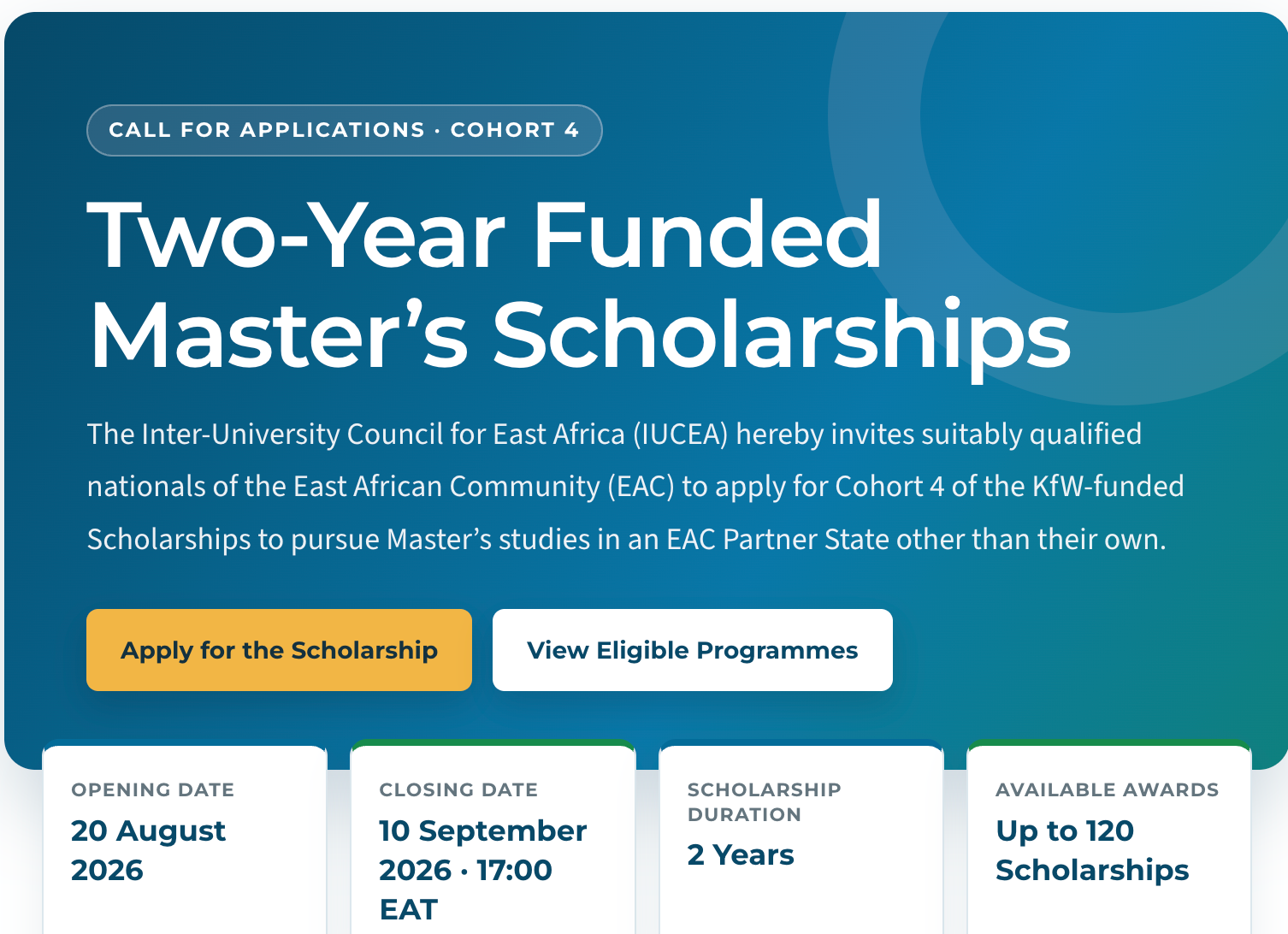
EAC Scholarship Programme Cohort 4 Is Open: Fully Funded Master’s Study Anywhere in East Africa
If you’ve been waiting for a real shot at a funded Master’s degree, this is worth stopping for. The Inter-University Council for East Africa (IUCEA), working with the Federal Republic of Germany through KfW, has just opened applications for Cohort 4 of the EAC Scholarship Programme (EACSP). Up to 120 fully funded scholarships are on the table for young people from across the East African Community who want to pursue a Master’s degree in a country other than their own.
That last part matters, so let’s say it plainly: you cannot apply to study in your own country. The whole point of this programme is regional mobility. A Rwandan applies to Kenya, Uganda, or Tanzania. A Kenyan applies to Rwanda or DR Congo. And so on. It’s built around the idea that East Africa’s future leaders should study, live, and build networks across borders, not just within them.
Key Dates You Need to Lock In
- Opening date: 20th August 2026
- Closing date: 10th September 2026, no later than 17:00 hours East African Time
- Virtual pre-application information session: 28th August 2026 at 11:00 AM East Africa Time (Nairobi time), for anyone who wants clarification before submitting. Registration is required through the Zoom link in the official call.
That’s a short window. Roughly three weeks. If you’re even slightly interested, start now rather than later.
Who Can Apply
To be eligible, you need to tick every one of these boxes:
- Be a citizen of one of the 8 EAC Partner States: Burundi, the Democratic Republic of Congo, Kenya, Rwanda, Somalia, South Sudan, Tanzania, or Uganda.
- Be below 35 years of age at the time of application.
- Apply to study in an EAC Partner State that is not your own country of citizenship.
- Hold a Bachelor’s Degree with at least Second Class Upper Division, Distinction, or an equivalent qualification.
- Have already applied for admission to an eligible Master’s programme at one of the partner universities.
- Submit a complete scholarship application within the stipulated application period.
Applications must be submitted in English. And notably, IUCEA is actively encouraging female applicants, persons with disabilities, and applicants from other disadvantaged backgrounds to apply. The programme is aiming for at least 50% female participation among scholarship beneficiaries, so if that’s you, this is a genuine invitation, not just a line in a document.
The Backstory: Why This Programme Exists
The EAC Scholarship Programme is a regional initiative jointly run by the East African Community and Germany, implemented through IUCEA. Its goal is to grow a generation of leaders who understand regional integration because they’ve lived it, by studying in a partner state and building relationships across the region.
Phase I of the programme ran from 2018 and supported 180 Master’s students across East Africa. Phase II kicked off in October 2025 and is targeting at least 280 students across three cohorts. This call is for the fourth cohort. The programme’s vision statement sums it up well: “Leadership to Foster Regional Integration.”
Scholarships are awarded in six thematic areas:
- Mathematics
- Engineering
- Informatics
- Science
- Technology
- Business Science
What the Scholarship Actually Covers
This isn’t a partial scholarship. Here’s everything included in the package:
- A return economy-class air ticket between your home country and your host country, covering both the start and end of your studies
- Full tuition fees, paid directly to the host university
- An arrival allowance of EUR 200, paid once you land and open a bank account in the study country (opening a EUR-denominated account is encouraged, since it helps avoid losses from currency conversion)
- A monthly stipend of EUR 380 for accommodation, meals, local transport, and other living costs
- A lump-sum allowance of EUR 650 for study materials
- A one-time EUR 1,500 study and research allowance
- Medical insurance for the full duration of the scholarship
- Coverage of visa or entry pass fees, where required
- Participation in at least one extracurricular event
The scholarship runs for 2 years, matching the standard duration of a Master’s programme.
Where You Can Study: 60 Programmes Across 5 Countries
This is the part that takes real time to go through, but it’s worth reading carefully because the right programme for you might be sitting in a country you hadn’t even considered. Applicants may apply to more than one eligible programme and/or university, though each one has to be submitted as a fully separate application.
Kenya
| University | Master’s Programme | Thematic Area |
| Chuka University | Applied Mathematics | Mathematics |
| Chuka University | Biochemistry | Science |
| Chuka University | Botany – Microbiology and Biotechnology | Science |
| Chuka University | Botany – Plant Pathology | Technology |
| Daystar University | Economics | Science |
| Dedan Kimathi University of Technology | Food Science and Technology | Technology |
| Dedan Kimathi University of Technology | Civil Engineering | Engineering |
| Egerton University | Animal Nutrition | Science |
| Egerton University | Food Science | Science |
| Jaramogi Oginga Odinga University of Science & Technology | Agricultural Extension | Science |
| Jaramogi Oginga Odinga University of Science & Technology | Chemistry | Science |
| Jaramogi Oginga Odinga University of Science & Technology | Microbiology | Science |
| Jaramogi Oginga Odinga University of Science & Technology | Pure Mathematics | Science |
| Kabarak University | Human Nutrition and Dietetics | Science |
| Kabarak University | Physics | Science |
| KCA University | Data Science | Technology |
| KCA University | Development Finance | Science |
| Kibabii University | Business Administration | Business Science |
| Kibabii University | Human Resource Management | Business Science |
| Kibabii University | Logistics and Supply Chain Management | Business Science |
| Kibabii University | Physics | Science |
| Murang’a University of Technology | Chemistry | Science |
| Murang’a University of Technology | Information Technology | Informatics |
| Murang’a University of Technology | Statistics | Mathematics |
| Murang’a University of Technology | Electrical and Electronics Engineering (MTech) | Engineering |
| Strathmore University | Computing and Information Systems | Technology |
| Strathmore University | Information Technology | Informatics |
| Strathmore University | Sustainable Energy Transitions | Science |
| United States International University-Africa | Communication Studies | Informatics |
| United States International University-Africa | Information Systems Technology | Informatics |
| United States International University-Africa | Organisational Development & Management | Business Science |
Rwanda
| University | Master’s Programme | Thematic Area |
| Institut d’Enseignement Supérieur de Ruhengeri | Microfinance | Business Science |
| Institut d’Enseignement Supérieur de Ruhengeri | Biomedical Laboratory Sciences | Science |
| Institut d’Enseignement Supérieur de Ruhengeri | Software Engineering | Science |
| Institut d’Enseignement Supérieur de Ruhengeri | Taxation | Business Science |
| University of Rwanda | Electrical Power Systems | Engineering |
| University of Rwanda | Pharmaceutical Analysis and Quality Assurance | Science |
| University of Rwanda | Health Supply Chain Management | Science |
| University of Rwanda | IoT – Wireless Intelligence Sensor Networks | Technology |
Uganda
| University | Master’s Programme | Thematic Area |
| Busitema University | Industrial Mathematics | Mathematics |
| Busitema University | Materials Engineering | Engineering |
| Mbarara University of Science & Technology | Biology (Microbiology and Parasitology) | Science |
| Mbarara University of Science & Technology | Biology (Natural Resources Ecology, Management and Conservation) | Science |
| Mbarara University of Science & Technology | Mathematics | Mathematics |
| Nkumba University | Information Systems and Technology | Technology |
United Republic of Tanzania
| University | Master’s Programme | Thematic Area |
| Dar Es Salaam University College of Education | Environmental Biology | Science |
| Dar Es Salaam University College of Education | Industrial Chemistry | Science |
| Dar Es Salaam University College of Education | Science with Education | Science |
| Eastern Africa Statistical Training Centre | Official Statistics | Mathematics |
| Sokoine University of Agriculture | Irrigation Engineering and Management | Engineering |
| The Nelson Mandela African Institute of Science and Technology | Data Science and Artificial Intelligence | Informatics |
| The Nelson Mandela African Institute of Science and Technology | Environmental Technology and Innovation | Technology |
| The Nelson Mandela African Institute of Science and Technology | Innovation and Entrepreneurship Management | Business Science |
| The Nelson Mandela African Institute of Science and Technology | Embedded and Mobile Systems (EMoS) | Science |
| University of Dar es Salaam | Chemistry | Science |
| University of Dar es Salaam | Manufacturing Engineering | Engineering |
| University of Dodoma | Biodiversity Conservation and Management | Science |
| University of Dodoma | Digital Instructional Design | Informatics |
| University of Dodoma | Cyber Security and Digital Forensics | Informatics |
| University of Dodoma | Public Health | Science |
Sixty programmes, spread across four host countries, in six thematic areas. Whatever your background, whether it’s engineering, agriculture, public health, finance, or cyber security, there’s a realistic chance something on this list fits you.
How to Apply: Two Separate Stages
This is where a lot of good candidates trip up, so read this part twice. Getting the scholarship is a two-part process, and both parts have to happen. Submitting one does not count as submitting the other.
Part A: Apply for University Admission First
- Review the call and pick your programme and university from the list above.
- Visit that university’s website and check its own admission process for the programme you want. Details are usually listed alongside the call for applications.
- Apply for admission, clearly stating your intention to apply for the EAC Scholarship Programme. Pay the university application fee if one is required.
Part B: Apply for the EAC Scholarship Itself
- Complete and submit the online EAC Scholarship Application form. The link opens on 20th August 2026 at https://ee-eu.kobotoolbox.org/J4W9xHf7
- Go through the Supporting Documents Checklist so you know exactly what’s needed for your case.
- Gather every required document into one folder, naming each file using the prescribed document code (for example, “E01 National ID”).
- Compress everything into a single zipped folder in PDF format and email it to both eacsp@iucea.org
Your email subject line has to follow a specific format: [Applicant Name] – Application for [Master’s Programme] at [University] – Phase II EACSP. For example: “Tsavo Simba – Application for MBA at Adroit University – Phase II EACSP.”
A few things worth flagging clearly:
- Applying for university admission does not count as applying for the scholarship. They’re two separate submissions.
- If you’re applying to more than one programme or university, each one needs its own complete, separate application, its own form, and its own email with a full set of supporting documents.
- If you submit more than once for the same programme, only your first submission counts, unless you email beforehand asking them to disregard the earlier one.
- Applications missing the complete online form or the required documents will not be considered at all during evaluation.
Supporting Documents You’ll Need
All documents must be submitted as PDFs in a single zipped folder, with each file named using its document code (E01, E02, and so on).
Mandatory documents (required for the application to be considered complete):
- E01 – National ID or Passport
- E02 – Passport Photograph (recent, colour, full head and upper shoulders)
- E03 – Proof of University Admission Application (admission letter, acknowledgement email, receipt, or portal screenshot)
- E04 – Bachelor’s Degree Certificate and Transcript (certified true copies; if obtained outside the host country, must be equated by the relevant national authority before admission; if not in English, must include certified translations)
- E05 – Curriculum Vitae (CV)
- E06 – Bank Statements, last six months, where applicable
- E07 – Academic Reference Letter
- E08 – Professional Reference Letter
Optional documents, but required where they apply to your situation (used to evaluate specific parts of your application):
- E09 – Recent Payslip
- E10 – Professional Membership Certificate
- E11 – Payslips, last six months, where applicable
- E12 – Scholarship Award Letter, if your undergraduate studies were funded by a scholarship
- E13 – Photograph of Primary Residence
- E14 – Publication, Research Paper, Award, Fellowship, Certification, or Other Achievement Evidence
- E15 – Leadership Certificate
- E16 – Volunteer Certificate
- E17 – Evidence of Dependents (marriage or birth certificates, guardianship documents, school fee receipts)
- E18 – Medical Report, for applicants with a disability or chronic illness
- E19 – Refugee Identification or Registration Documents
- E20 – Displacement, Disaster, or Social Welfare Documentation
- E21 – Evidence of Loss of Livelihood (termination letter, closure notice, etc.)
- E22 – Tuition Arrears Statements, Fee Balance Statements, or Financial Aid Applications
- E23 – University Correspondence Demonstrating Financial Hardship
- E24 – Any other relevant documents, such as an English Language Proficiency Certificate (IELTS, TOEFL, where applicable)
Important Notes Before You Submit
- Only complete applications, for eligible programmes, submitted before the deadline, in English, and following the guidelines, will be considered.
- You must complete both stages: university admission and the separate scholarship application.
- Missing mandatory documents means your application is deemed incomplete and won’t move forward.
- Applying for more than one programme means a full, separate application for each one.
- Only shortlisted applicants will be contacted, so don’t expect a response if you’re not selected.
- False, misleading, or incomplete information can get you disqualified at any stage, or lead to a scholarship being withdrawn after the fact.
- IUCEA reserves the right to verify anything you submit.
- Successful applicants may start at the earliest available intake, depending on each host university’s academic calendar.
- Submitting an application never guarantees an award.
- The scholarship cannot be deferred or transferred to someone else. If you’re awarded it and don’t take it up, it will be withdrawn.
By applying, you’re agreeing to comply with all conditions of the call, and IUCEA and KfW reserve the right to reject any application that doesn’t meet the eligibility and selection requirements.
Full Timeline
| Activity | Timeline |
| Launch of the Call for Student Applications | 20 August 2026 |
| Student application period / receipt of clarifications | 20 August – 10 September 2026 |
| Virtual pre-application information session | 28 August 2026 |
| Closing date for applications | 10 September 2026 |
| Communication of successful students and host universities | December 2026 |
| Acceptance of scholarship offers and signing of agreements | December 2026 |
| Pre-Travel and Pre-Award Orientation and Reporting to Universities | In accordance with university academic calendars |
| Reporting and registration of students at host universities | In accordance with university academic calendars |
Need Help or Have Questions?
For clarification on the call itself, reach out to:
- IUCEA: eacsp@iucea.org