

Should I Go to Form Five or Join College After Form Four? A Complete Guide for Students After O-Level Education
One of the most common questions students ask after completing Form Four is:
“Should I continue to Form Five and Form Six, or should I join college immediately?”
Another common question is:
“If I choose college, which course should I study?”
These are important decisions that can shape your future career and educational journey. In this article, we will discuss the advantages and challenges of both options to help you make an informed choice.
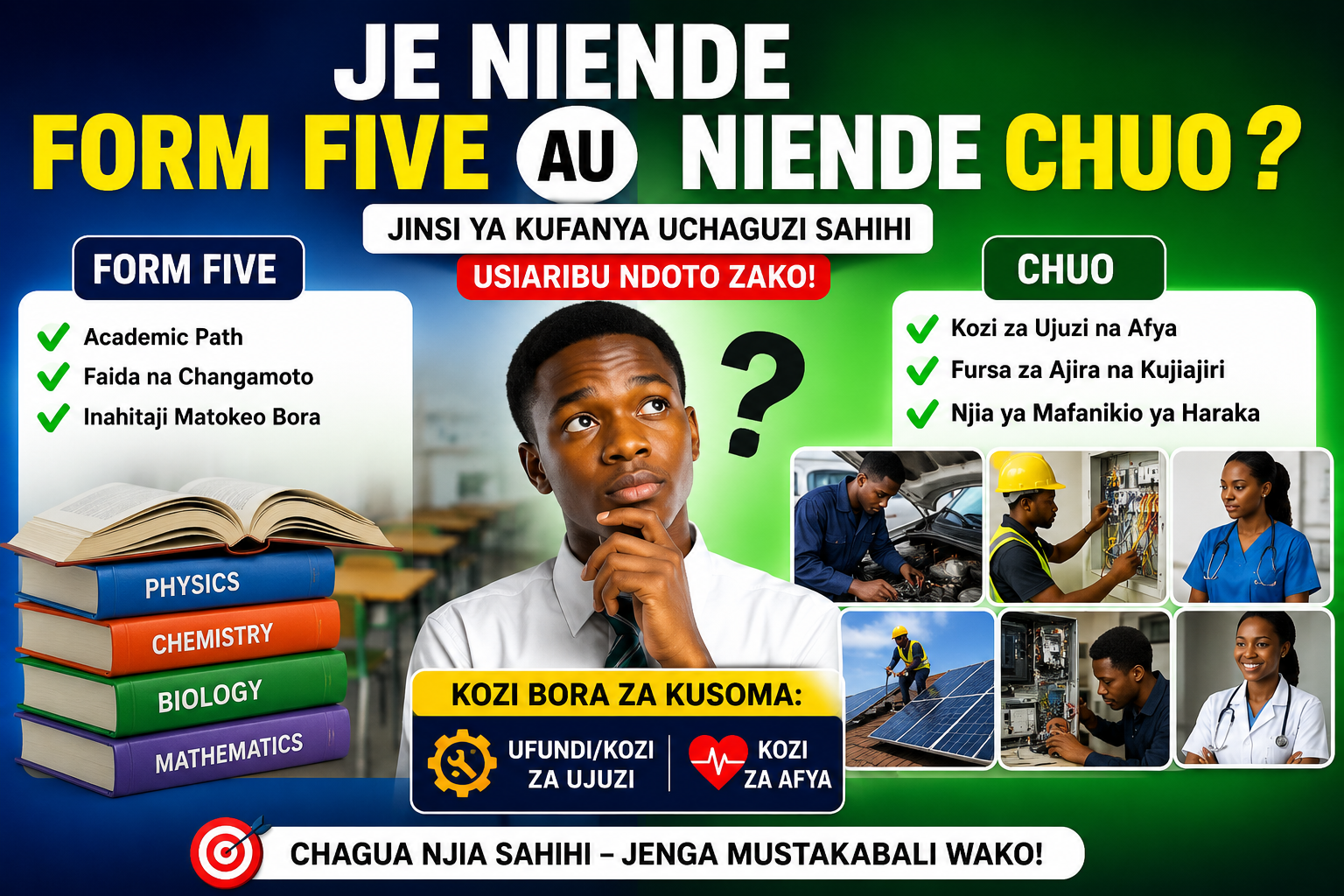
Understanding the Form Five and Form Six Path
For many years, Form Five and Form Six have been considered the traditional route to higher education. Students who perform well can proceed to university and pursue professional careers.
However, there are different opinions about Advanced Level education. Some people believe it is an important stage for academic growth, while others feel it can delay students from entering career-focused training.
Challenges of Choosing Form Five
One of the biggest challenges is that students often select combinations based on their dream careers but later struggle to achieve the grades required for university admission.
For example, a student studying the PCB combination (Physics, Chemistry, and Biology) may dream of becoming a medical doctor. However, if the student obtains lower grades in Form Six, such as Division III or Division IV, gaining admission into a Doctor of Medicine (MD) program becomes very difficult.
As a result, some students spend two years in Advanced Level education but still fail to qualify for their desired university courses.
When Should You Choose Form Five?
You should consider Form Five if:
- You have strong academic abilities.
- You are confident you can achieve high grades.
- Your dream career requires university education through the Advanced Level route.
- You are prepared for the academic competition that comes with A-Level studies.
For academically strong students, Form Five remains an excellent pathway toward university education and professional careers.
When Should You Choose College?
If you feel that Advanced Level may not be the best fit for you, joining a college after Form Four can be a smart decision.
College programs often focus on practical skills and career preparation. Instead of spending two years in A-Level studies, you can begin training directly in a field that matches your interests and career goals.
Which College Course Should You Choose?
If you decide to join college, choosing the right course is critical.
In today’s job market, skill-based and health-related courses offer some of the best opportunities for employment and self-employment.
Why Skill-Based Courses Are Important
Modern employers are increasingly looking beyond certificates. They want people who can demonstrate practical skills and solve real-world problems.
Skill-based courses can help you:
- Find employment more easily.
- Start your own business.
- Build practical expertise.
- Create multiple income opportunities.
Recommended Skill-Based Courses
Some of the most marketable vocational and technical courses include:
- Automotive Mechanics
- Electrical Installation and Maintenance
- Plumbing
- Mobile Phone Repair
- Computer Repair and Maintenance
- Solar Energy Installation
- Mechanical Engineering Trades
- Heavy Machinery Operation
- Professional Driving
- Construction Technology
- Carpentry and Joinery
- Other Technical and Vocational Trades
These courses provide hands-on experience and practical skills that are highly demanded in the labor market.
Best Health Courses to Study
The healthcare sector continues to grow globally and offers excellent career opportunities.
Some recommended health-related courses include:
Nursing
Nursing remains one of the most respected and employable professions worldwide. Qualified nurses are needed in hospitals, clinics, and healthcare organizations.
Specialized Medical Programs
Instead of focusing only on becoming a general medical doctor, students can explore specialized healthcare careers such as:
- Optometry (Eye Care)
- Dentistry
- Ear, Nose, and Throat (ENT) Healthcare
- Orthopedic and Bone Care
- Medical Laboratory Sciences
- Radiology and Imaging
These fields often have strong employment opportunities and growing demand.
Public Health
Public Health is another valuable course that focuses on disease prevention, health promotion, and community well-being. It offers career opportunities in government agencies, NGOs, hospitals, and international health organizations.
Final Thoughts
There is no single answer to the question, “Should I go to Form Five or join college?”
The best choice depends on your academic strengths, career goals, and personal interests.
- If you are confident in your academic performance and wish to pursue university studies through the traditional route, Form Five may be the right choice.
- If you prefer practical skills, faster career preparation, and employment opportunities, joining a college could be a better option.
The most important thing is to choose a path that aligns with your abilities and long-term goals. Success comes not only from the level of education you pursue but also from the skills, knowledge, and dedication you develop along the way